


The seawater cooling system of ships relies on clean water sources. Seawater often contains jellyfish, seaweed, silt, plastic bags and small shellfish. Once these impurities enter the engine heat exchanger or air conditioning condenser, they will clog the flow channels.Blockage can lead to a decrease in cooling flow, an increase in engine temperature, and in severe cases, cause equipment damage.The function of the seawater strainer is to intercept these impurities before the seawater enters the water pump.It is a crucial protective component between the sea valve and the seawater pump.
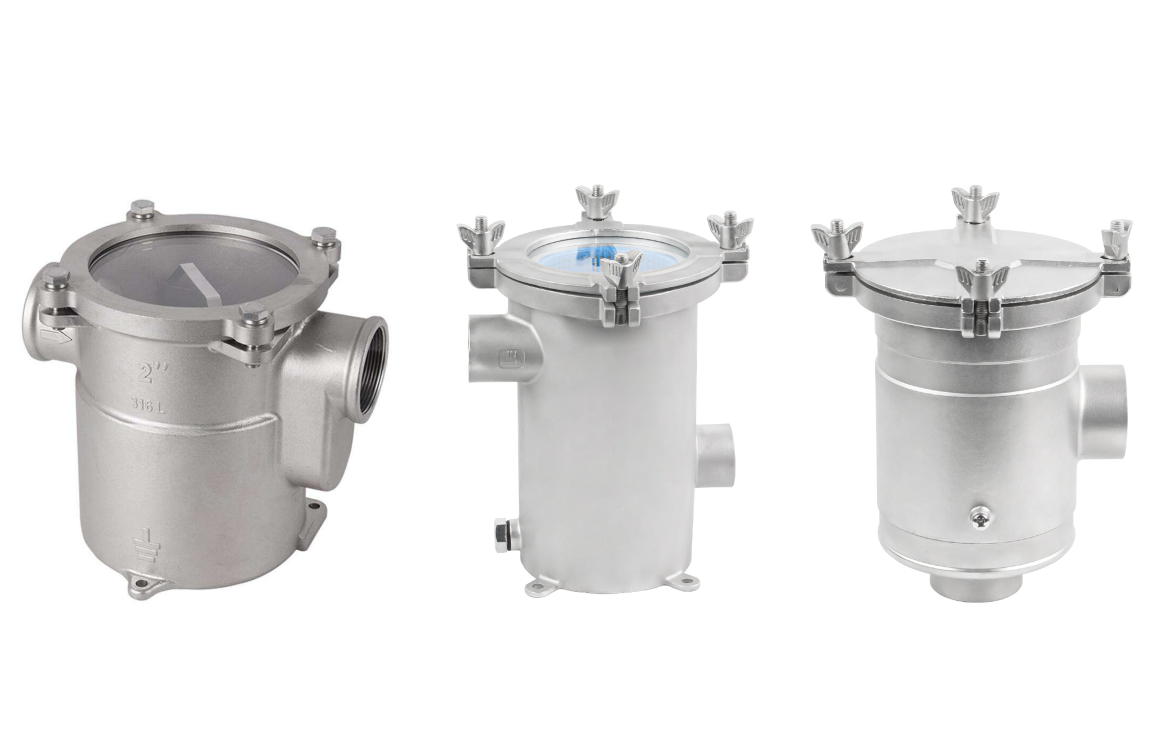
The three 316 stainless steel seawater strainer to be introduced next have different inlet and outlet methods: the ordinary type, the side-in side-out type, and the bottom-in side-out type. Users should choose the appropriate model based on the pipe size, the engine room space, and the water introduction method.
Step 1: Determine the size of the interface
It is recommended to choose the large-sized seawater strainer. For instance, if the engine interface is 1.5 inches, a 2-inch seawater strainer can be selected and connected through a reducer fitting.The seawater strainer in the top grade have a larger internal filter area and lower water flow resistance, allowing the cleaning cycle to be doubled. The product offers interface specifications ranging from 1 inch to 4 inches, covering the needs of most small vessels.
Step 2: Select the method of water entry and exit based on the cabin space.
Situation 1: Vertical height exceeds 300 millimeters
Choose the standard type. The filter is cylindrical in shape, with a height ranging from 125 to 355 millimeters.
Situation 2: The vertical height is less than 200 millimeters, and there is installation space on the side.
Choose the side-in, side-out type. The seawater enters from one side and flows out from the other side. The overall height of the filter is less than 140 millimeters.
This model is suitable for installation on ships with limited cabin height. The seawater strainer can be hung sideways on the bulkhead and the pipeline is arranged horizontally.
When installing, two points should be noted: First, the inlet and outlet ports must be kept level to prevent debris from accumulating unevenly inside the strainer.Secondly, the opening direction of the end cover should be designed to provide sufficient operation space. It is recommended to leave a distance of one fist’s width.
Situation 3: Use the sea valve at the bottom of the ship to directly introduce water, and hope that impurities will naturally settle.
Choose the bottom-in and side-out type. The seawater enters from the bottom and flows out from the side.The unique advantage of this model lies in the fact that sediment will accumulate at the bottom of the seawater strainer. The seawater flows from bottom to top, and the heavier impurities will settle at the bottom and are less likely to block the outlet.During cleaning, simply unscrew the side end cover and use fresh water to rinse from the outlet in the reverse direction. The sediment will then be discharged from the bottom.It should be noted that the seawater strainer body should not be too low below the ship’s waterline. Otherwise, even after closing the sea valve, a siphon effect may still occur, which could interfere with the maintenance operation.
A suitable seawater strainer, when properly installed and cleaned regularly, can prevent the engine from overheating and getting damaged due to debris blockage.If you still have any questions regarding the specific model selection or installation dimensions, please feel free to contact our team to obtain the drawings and more detailed information.
Post time: Apr-17-2026